
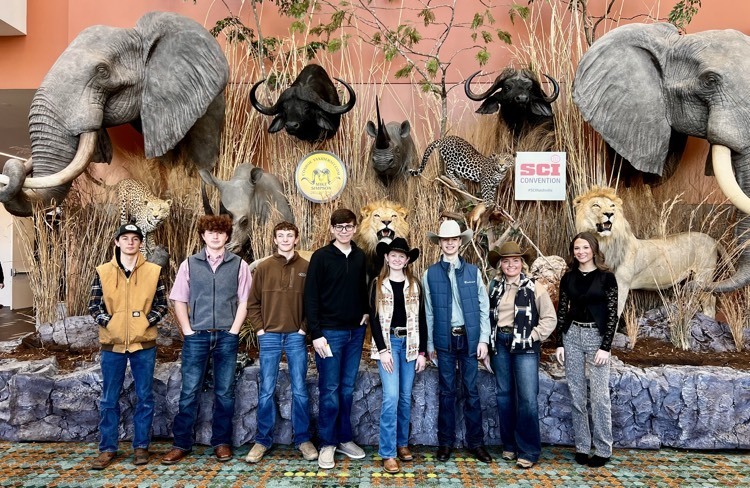
Students traveled to Nashville, Tennessee for a powerful real-world learning experience at the annual convention of Safari Club International, held at the Music City Center in Nashville. What they encountered was far more than a convention floor filled with outdoor exhibitors. They witnessed a living example of the global economy in motion and the complex relationship between conservation, commerce, policy, and education.
Safari Club International, commonly known as SCI, is an international organization founded in 1972 that advocates for wildlife conservation, sustainable-use hunting practices, and the protection of hunters’ rights. With more than 150 chapters worldwide and members across multiple continents, SCI works to influence wildlife policy, protect habitat, and fund conservation initiatives. The organization has contributed millions of dollars toward wildlife research, anti-poaching efforts, and habitat preservation projects both in the United States and internationally. Its annual convention is one of the largest gatherings of its kind, bringing together hundreds of exhibitors, conservation leaders, policymakers, outfitters, manufacturers, and outdoor professionals from around the world.
For students, the experience provided a firsthand look at how industries operate within a global marketplace. The convention floor represented international trade in action. Outfitters from Africa, Europe, and North America connected with clients and partners. Manufacturers showcased advancements in optics, technology, and sustainable equipment. Conservation groups presented data on wildlife management strategies. Business transactions occurred alongside educational seminars discussing ethics, wildlife law, and environmental stewardship. This intersection of economics and conservation demonstrates that environmental responsibility and economic impact are not isolated topics but interconnected forces shaping communities worldwide.
The convention also highlighted the importance of responsible wildlife management. SCI promotes the principle of sustainable use, which supports regulated hunting as a conservation tool when guided by science and law. In many regions, regulated hunting funds habitat restoration, supports rural economies, and provides incentives to preserve wildlife populations. Students were able to observe how data, policy, and economics combine to shape these decisions, reinforcing lessons they study in classrooms about supply and demand, public policy, and environmental science.
Most importantly, this experience underscored the critical role of youth engagement. Positive, real-world educational opportunities help students move beyond theory into understanding. When young people see professionals debating conservation policy, negotiating business partnerships, and discussing ethical responsibility, they begin to imagine their own future roles in these fields. Exposure to global conversations builds confidence, critical thinking skills, and a sense of civic responsibility.
Education is strongest when students can connect academic concepts to real experiences. Visiting a major convention such as this allows students to witness leadership, entrepreneurship, advocacy, and scientific discussion in one setting. Whether their future paths lead them into conservation, law, business, journalism, or public service, experiences like this broaden their perspective and challenge them to think deeply about how economic systems and environmental stewardship must coexist.
The future of conservation and responsible global trade depends on informed, engaged young leaders. By stepping into environments where real decisions are discussed and real industries operate, students gain more than knowledge. They gain vision. They see that their education is not confined to textbooks but connected to the real world. And through positive, guided experiences such as this trip, they begin to understand that they have a role to play in shaping a balanced and sustainable future.